The Japanese Eye

The Japanese Eye

Year 2010. I'm walking my usual route, riding my usual train. Not any particularly new things in sight, same people around, same fashion that hasn't changed much over the last ten years. Ten years since the beginning of the 21st century. The true form of that Future, dreamed by people of the past, is nothing more than our overly common Present, because, as obvious as it sounds, today is merely a continuation of yesterday. This is a bit sad.
However, as we look closer, we'll realize that this viewpoint is extremely superficial. The truth is that our world has drastically changed during the last ten years. The whole world, even if we cannot perceive it immediately, is living inside the very train I am in. Communication, trough the spread of the Internet, has taken away the physical barriers of our planet. We are living in an era where we can share whatever information, whatever the time and wherever the place. Those same people always seated in front of me all keep their eyes fixed on the screen of these portals to the world that they all carry in their pocket.
Every possible piece of knowledge is dispatched, consumed and forgotten at the same time all over the planet. I could hear a popular song in a London club, on a street corner in New-York city the next day and then again in a Tôkyô taxi on my trip back home.
Our background, our language, our history may be different, but we can all talk together with the same excitement about same topics. We have started to slip through the present idea of nation to connect ourselves to a shared horizon. And this goes even further. There's no way we will be able to stop these new paths to develop, may they be good, may they be bad.
On one hand, this is amazing, but on the other hand it carries a risk; the risk of a dulled, standardized, uniform culture. As complex and diverse information may be, it homogenizes ways of thinking. Same values, shared words, similar discourse, a global village without history. What is lost here? Which should be the peculiar characteristics to be underlined in such a time?
The answer would be the rich cultural legacy that people spent time nurturing and the perception of beauty that gave birth to it. These are not things that I have built today or the day before, neither things that we can share in the few seconds of a Youtube clip. These are rather a background so familiar that we cannot see it anymore and values that slowly disappear precisely because they are too close to us.
The fact that we live in an age of rapid globalization led us to realize that true perception of local peculiarities can give us strength. While we understand the synchronicity and the unstoppable nature of information today, we would like to grasp the essence of our inherent and immovable sense of beauty.
Half a century ago, in 1957, Yanagi Muneyoshi (1889-1961), leader of the Japanese Mingei (Folk crafts) movement, found the power to write an essay titled The Japanese Eye despite his illness. That was four years before his death. In that short 15 pages-long text, he managed to concentrate and summarize his thoughts and principles so well that this essay, a virulent but clever criticism of his time, still makes sense in today's Japan. The text starts like that:

«The National Museum of Modern Art in Tôkyô recently published its monthly paper under the title The Modern Eye, while holding an exhibition on the same subject. However and without much surprise, under closer inspection, the whole affair is more about a Western Eye. Does it implies that the Modern Eye is Western or maybe that the Western Eye is modern? Both ways, I feel deeply offended by such statements.
[…]
Thus, even weak and still confined to my bed, the will to defend the idea of a Japanese Eye led me to write this essay. Japan should believe firmly in the Japanese Eye and therefore think that it is its duty to share it with the world. Bragging in vain about it would be foolish, but I believe that the time has come for Japan to promote with confidence its particular viewpoint. Is the Japanese way any duller than the Western way? Do we feel shame for our backwardness in regard to a Modern Way? My opinion is that the brilliant and ever-spreading Western Eye would find treasures in its Japanese counterpart, because the Japanese Eye is built on a long and solid tradition.»
YANAGI Muneyoshi, Cha to Bi, p. 314-315, Kôdansha gakujutsu bunko, 2000

For Japan, modernization and westernization have been synonyms. This is the reason why this essay represents for the author a criticism of Modernism. Globalization of the 21st century is unrelated to the events that affected Yanagi half a century ago, but his bold approach keeps on living and encourage us to perpetuate the very concept of Japanese Eye that we borrowed from him.

When we use the expression Japanese Eye, what does the word eye relates to?

The idea of eye relates to the concept of appreciation of beauty. What can be described as beautiful? How to detect beauty? The word eye relates to that very approach. This refers as well to things that every one of us nurture in our hearts, and at the same time to things that we can learn when looking for the diverse values that make us all different.
Beauty appreciation, historically inherent to a place, is a thing that has always existed regardless of the time. But if we, individuals living in the present, don't give ours a new breath, we won't be able to pass it further on. Conscience is not the matter of others. It is my concern as much as yours to keep it alive.

And so, what would be Japanese in that Japanese Eye?

The question is to understand what distinguish the Japanese Eye from other approaches. But then, was there even such a concern in the past? Did it keep on existing? Does it still exist today?
For us, those are questions both old and new. However, in our case there is no word to answer them. We consider that the answer has to be shaped so that it can be seen. The reason is that this is not a concept to be taken abstractly, but rather an idea that should exist concretely.
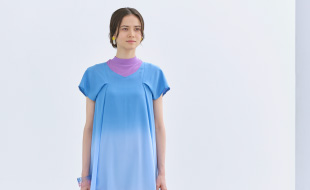
Because we are born in Japan, because we live here, we think of rediscovering one by one the manifestations of the Japanese Eye that tend to disappear, and we wish to do so following matohu's way. But rather than strictly observing tradition and fixed rules, we hope to empathize with people of our time and share a same excitement.

This new eye, this new approach overlooked until now has the power to bring us to a halt, to make us focus, to awaken us. Its suddenly obvious existence in our everyday life has the ability to transform us.
This new eye gives us one more way to look at things and symbolizes the beginning of a fruitful era. As usual, the world is quietly waiting for us to look at it.